Beyond the Map: Contextual Navigation
How predictive routing and intelligent EV charging are transforming the way we get from point A to point B.
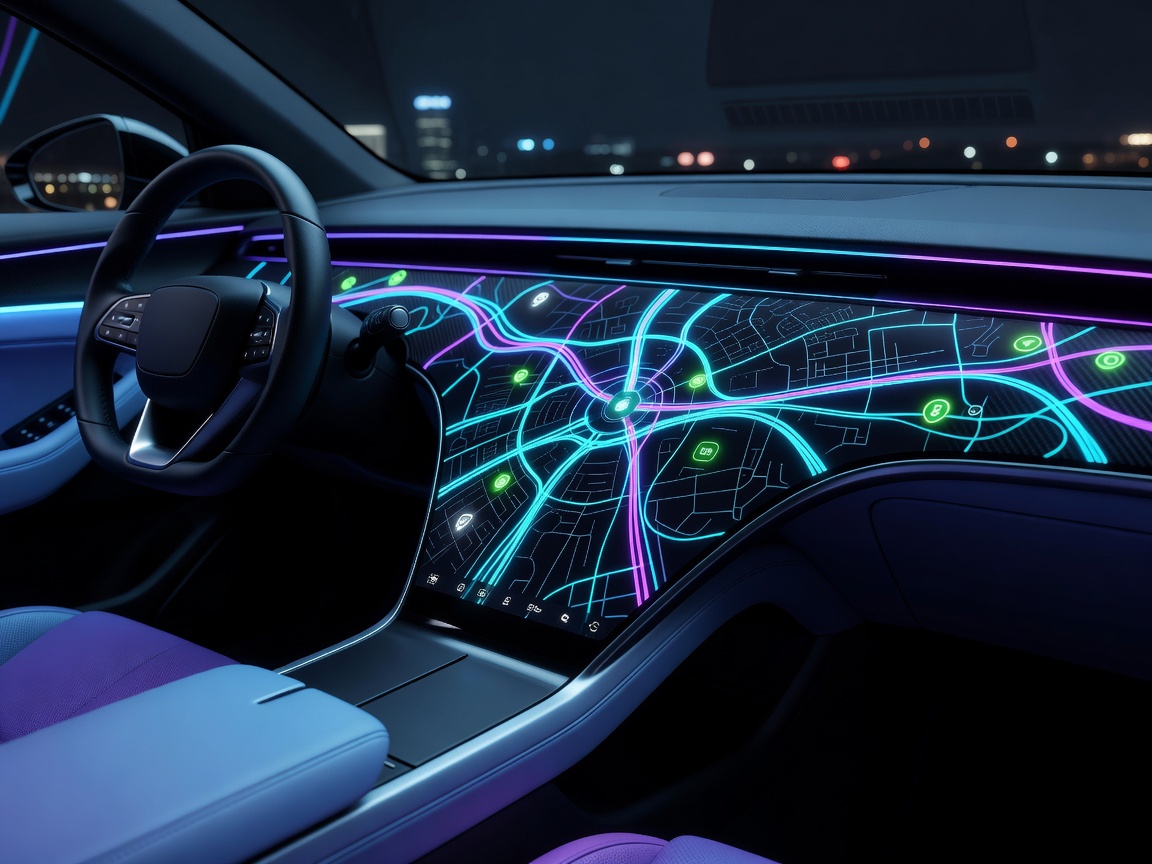
The Evolution of Wayfinding
Turn-by-turn GPS navigation changed the world, but it remained a largely static tool. You entered a destination, and the system calculated the shortest or fastest line based on traffic data. It was reactive. Today's AI-powered personal assistants have ushered in the era of Contextual Navigation—a dynamic, predictive approach that understands not just where you are going, but why, when, and under what conditions.
Contextual navigation synthesizes data from multiple disparate sources: the driver's personal calendar, historical driving patterns, real-time weather, municipal infrastructure data, and the vehicle's own internal state. The result is a navigation experience that often anticipates the destination before the driver even initiates a command.
Predictive Routing and Habit Analytics
Through machine learning, the vehicle's AI quickly builds a profile of the user's habits. If you leave the house at 7:30 AM every weekday, the assistant primes the route to the office, instantly factoring in current traffic conditions. However, contextual navigation goes deeper.
If your calendar shows an off-site meeting at 9:00 AM, the AI overrides the usual office route and calculates the path to the meeting location instead. If the weather forecast predicts heavy snowfall, the AI might suggest an earlier departure time or route you away from steep inclines and unplowed secondary roads, even if it adds miles to the journey.
Intelligent EV Range Management
Perhaps the most critical application of contextual navigation is in Electric Vehicles (EVs). Range anxiety has long been a barrier to EV adoption, largely because early range estimators were notoriously inaccurate, relying on simplistic linear calculations. AI has fundamentally solved this.
When calculating a route, modern AI assistants perform complex, multi-variable calculus to predict energy consumption. The system evaluates:
- Topography: Elevation changes along the route (accounting for regenerative braking on downhills).
- Weather: Ambient temperature (which affects battery efficiency) and wind resistance.
- Driving Style: The driver's historical acceleration and braking habits.
- Cabin Loads: Energy required by the HVAC system to reach the desired interior temperature.
If the destination is beyond the current range, the AI doesn't just warn the driver; it seamlessly integrates charging stops. It assesses the real-time availability of chargers, their output speeds, and exactly how long you need to plug in to reach your destination with a safe buffer, turning long-distance EV travel into a frictionless experience.
Hyper-Local and Dynamic POIs
Points of Interest (POIs) are no longer static list entries. In a contextual framework, asking the assistant to "find a coffee shop" yields highly curated results. The AI knows you prefer drive-throughs on weekday mornings but sit-down cafes on weekends. It knows the vehicle dimensions and can filter out parking garages with low clearance. It can even parse real-time wait times or inventory levels at specific stores.
Conclusion
Contextual navigation represents the shift from a vehicle being a tool you operate, to a partner that anticipates your needs. By combining environmental awareness with personal data and vehicle telemetry, AI assistants are ensuring that drivers navigate the world more efficiently, safely, and comfortably than ever before.